

You Make Sense
If you (or your team) are feeling wrung out, you're not alone. Here's something that can help.

Since the start of my business, I have heard 1,000 variations on the same theme. It goes something like this:
“Our People Need Help Because Everything is Bat Shit Crazy Hard Right Now”
The melodies and harmonies vary: fast growth, not enough resources, layoffs, clients that expect answers yesterday, internal structural changes, intense external market competition, expected responsivity (someone is always awake with questions, someone always needs to have answers, and we all have devices that instantly bridge the gap between them), all amidst unprecedented uncertainty (AI, politics, global unrest).
From COVID, through the great resignation, quiet quitting, RTO mandates, social and political unrest and violence, AI, upheaval has become the new normal. The social, emotional and psychological consequences of the world turned upside down and inside out sit on every desk, in every department, of every industry. We are all impacted.
Also, we are humans who work (not workers who are sometimes human). Life is life-ing. People are falling in and out of love, moving, dreaming, grieving, heartbroken, having fertility challenges, trying to plan weddings, caring for aging parents, sick kids, sore backs, hormones, friends in need, and on and on.
It’s a time.
The thing is, it’s been a time for a while.
Of course people are reactive, exhausted, cynical (“here we go again!”), frustrated, and fried. It makes sense.
You make sense.
So what is there to do? Well, exactly what we are … right here, right now. And that’s what I tell the employers who call me:
Normalize and acknowledge what you and your people are experiencing.
It does more than you think it will. Let’s work it out together.
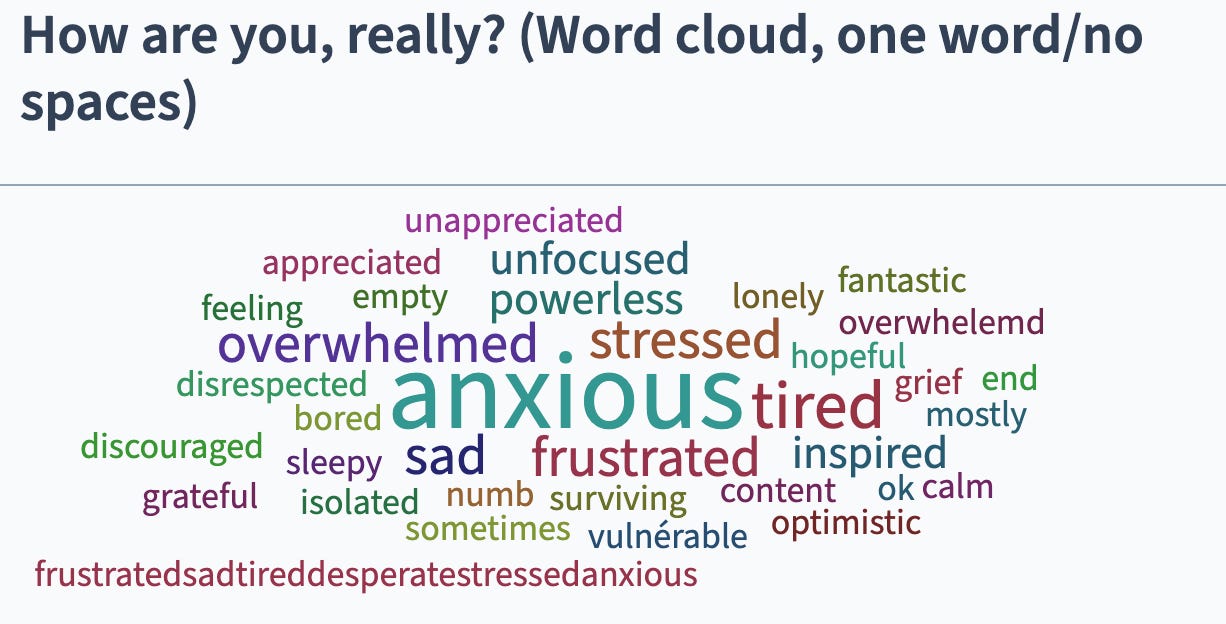
Genuinely, I am curious, how are you, really?
This word cloud is what I heard running a program for a small leadership group earlier this week. The “frustratedsadtireddesperatestressedanxious” came on the screen, and the whole room spoke up in agreement. Yes! That! There was a glorious exhale: I am not alone in this struggle. There is nothing wrong with me for feeling the way I do. I make sense. This feels hard, because it is.
As Strivers, we prioritize doing over being, moving or stillness (unless stillness is conceptualized as an action item, in which case it becomes more grey territory). Sometimes we just need to name things, to allow ourselves to hold the totality of our context and complexity without doing anything with it. Identifying and acknowledging don’t always shift the weight around… a lot of the time, though, I find they do. My observation is that the difference between when it shifts and when it doesn’t lies in the genuineness of the compassion and care present in the inquiry.
If you are an organization, this often raises a number of reservations:
Won’t this just become venting and complaining and make it much worse? Not if it’s facilitated properly. There is a fine line between acknowledging and ruminating, and the skill here is to sit without blame or judgment: to ask what is happening and how you are experiencing it matters. It helps leaders not only feel heard (and valued) but also less lonely.
Our people don’t talk about feelings, and don’t like to focus on what’s hard. They just wanted to get the job done. For folks unaccustomed to talking about emotional impact, we can start with physical impact: the hours are long, I wonder if you’ve been sleeping? What’s keeping you up? That sounds stressful. Is anyone here stressed? What else? (and lo and behold, here we are in the land of emotions). You don’t have to belabour anything. It’s just about naming their experience to help wrap their arms around it more fully and completely.
But we can’t change that it’s hard, so why would we draw attention to it? This is the equivalent of saying we don’t talk about the elephant in the room. If everyone knows and sees the elephant, it is imperative to acknowledge its presence. Sure, it doesn’t make it go away, but it at least makes sure everyone feels on the same page about it being there.
What if we make it worse? Say the wrong thing? Or realize people are suffering and our hands are tied? There are skills involved in being with complexity and hardship, especially when power dynamics are present, and there is no opportunity to hear what’s hard and make changes. With that said, that’s why there are trainings, external facilitators, and coaches who can help. If this is out of your wheelhouse, that’s a reason to grow, not to shy away.
So, how does normalizing look?
Well, for yourself, you want to embrace gentleness. Simply listing everything you are dealing with doesn’t land the same way as allowing yourself to sort through things more carefully. Perhaps, if you are feeling the weight and heaviness of an overwhelming season right now, these questions can help clarify how you make sense:
How many things are calling your attention right now? (here feel free to let loose and let the list fly)
Slow it down now, trace how your sense of security or your care are tied to each of your to-dos
How important does each item feel? How high do the stakes feel to you?
When was the last time you had a moment to just be with your thoughts, leisurely?
When you wake up in the morning, are you rested?
When was the last time you laughed so hard you cried?
Have you been able to move at all (outside, inside, a walk, a stretch, something more than getting lunch or going to that meeting) recently?
When was the last time you got a hug or held someone’s hand?
There is no good or bad, no right or wrong answers here. There is just the reality that you are carrying more than your weight around these days. Resist the desire to diminish your experience by comparing it to something worse. Care is not a scarce resource. How you feel makes sense, your struggles make sense, and your striving to continue showing up and trying is not only courageous, it is truly remarkable.
If you are a leader, you can follow this loose formula:
Identify the challenges/context + name the emotional impact + add specific gratitude
For example: We’ve been shorthanded for months (the challenge), it’s been stressful and disappointing not to have more support (emotions), I appreciate how you stayed late last week to help us finish the month-end reporting, and how you made an effort to make sure everyone had eaten dinner too (specific gratitude).
If you feel equipped to listen, validate and reflect back how your team makes sense, you can also invite them to share how they are holding up by asking:
How are you experiencing (list organizational context that impacts them)?
What are you juggling these days? [listen] How’s holding [what they say they are juggling] impacting you?
How are you, really?
It’s not about solving life, making the hard go away, or smoothing everything out. We can only control what we can control, and we are all limited. You can't take the hard away. But you can make sure no one is holding it alone. And that is leadership.
If I could add one more thing, less because it is immediately relevant and more because I have a strange feeling it needs to be registered too: Just being you happens to be enough, even if it feels like the sky will fall and the walls will crumble unless you are somehow more.
As always, be gentle on yourself and with one another